 Flag Grids
How to Play Higher or Lower: Population
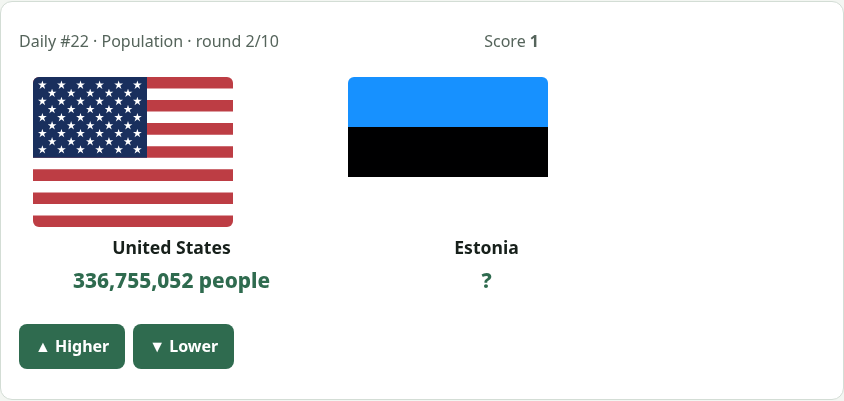
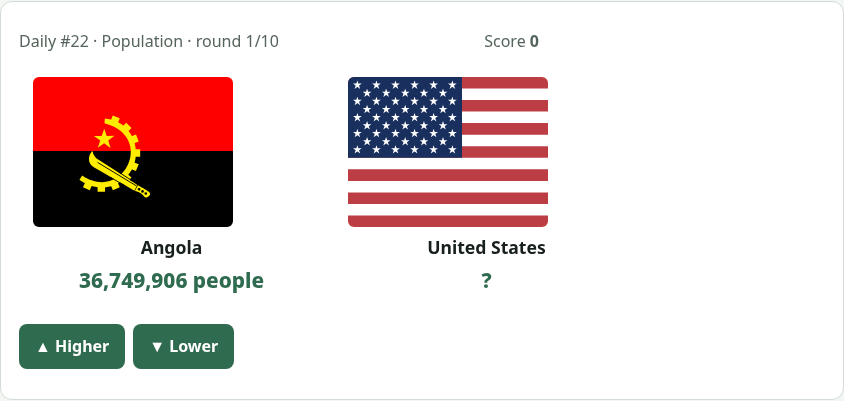
- See the first country. The left card shows a country, its flag and its population.
- Meet the challenger. The right card shows a new country with its population hidden.
- Choose Higher or Lower. Decide whether the challenger has more people (Higher) or fewer people (Lower) than the first country.
- See the result. The real figure is revealed. If you are right, the challenger becomes the new reference country. One wrong answer ends the run.
- Play ten rounds. The daily run is up to ten rounds long. Your score is the number of correct answers before your first miss, shown as a row of green and black squares.
- Go endless. In unlimited mode, keep playing until your first mistake and switch between population and area.
What Is Higher or Lower: Population?
Higher or Lower: Population is a quick geography game about one of the most surprising facts about the world: how many people live in each country. Each round shows two countries side by side with their flags. You know the population of the first one; your job is to decide whether the second country has a higher or lower population. Get it right and the challenger becomes the new reference point. The daily game has up to ten rounds, the same for every player. One wrong answer ends your run, so your score is how far you get.
Population questions sound easy until you play. Is Vietnam bigger than Germany? (Yes, by more than 15 million people.) Does Canada have more people than Poland? (Only just.) Are there more people in Egypt or in Iran? Questions like these trip up even well-travelled players, and that is exactly what makes the game addictive.
Rules and Scoring
| Rule | Detail |
|---|---|
| Daily rounds | 10 |
| Choice | Higher or Lower |
| Score | Correct answers before the first miss (max 10) |
| Unlimited mode | Endless until the first mistake; population or area |
| Data | World Bank 2023 population, mledoze/countries areas |
| Countries | Population above 100,000 |
Tips and Strategies
Memorise the top ten
About half the world’s people live in the ten most populous countries: India, China, the United States, Indonesia, Pakistan, Nigeria, Brazil, Bangladesh, Russia and Mexico. Whenever one of these appears, the answer is almost always “higher” unless the other card is also in the top ten.
Use benchmarks
Pick a few anchor numbers and compare against them. Japan has roughly 125 million people, Germany about 84 million, the United Kingdom and France about 68 million each, Spain about 48 million, Canada about 40 million and Australia about 27 million. Most comparisons become much easier when you can place each country above or below an anchor.
Don’t confuse size with population
Large countries are not always populous. Mongolia, Kazakhstan, Australia, Canada and Libya are huge but relatively empty, while Bangladesh, the Netherlands, Rwanda and the Philippines are small but crowded. If you are playing area mode in unlimited, flip this thinking around.
Remember fast-growing regions
Many African countries have grown quickly in recent decades. Nigeria, Ethiopia, Egypt, the Democratic Republic of the Congo and Tanzania all have populations in the tens of millions or more, larger than most European countries. Players who rely on old textbooks often underestimate them.
Think about neighbours
Neighbouring countries can differ enormously in population: Portugal and Spain, Uruguay and Argentina, Nepal and India. Comparing neighbours helps you calibrate the less familiar country.
Features
- Ten daily rounds: a shared challenge you can compare with friends.
- Unlimited mode: chase a personal best with population or area.
- Flags on every card: learn flags while you learn numbers.
- Trusted data: World Bank population estimates.
- Streaks and best scores: saved in your browser.
- Emoji sharing: post your daily result.
Why Population Comparisons Teach So Much
Higher-or-lower games became popular because they are instantly understandable and endlessly replayable. With countries, the format also teaches real knowledge. Population is one of the most important facts about a country: it shapes its economy, its politics and its influence in the world. Yet most people have only a vague idea of where countries rank. A few minutes a day with this game fixes that. You will soon know that Indonesia has more people than Brazil, that the Philippines has more than Japan, and that Nigeria has more than Russia.
The game also builds number sense. Comparing 38 million with 45 million or 9 million with 11 million sharpens estimation skills that are useful far beyond geography. That is why teachers often use population comparisons in maths and social studies lessons.
More Games to Try
After your ten rounds, test your map knowledge with Country Shape, then try the flag challenges Guess the Flag and Flag Connections. For something creative, make a shareable collage in the Flag Grid Maker.