 Flag Grids
How to Play Flag Connections
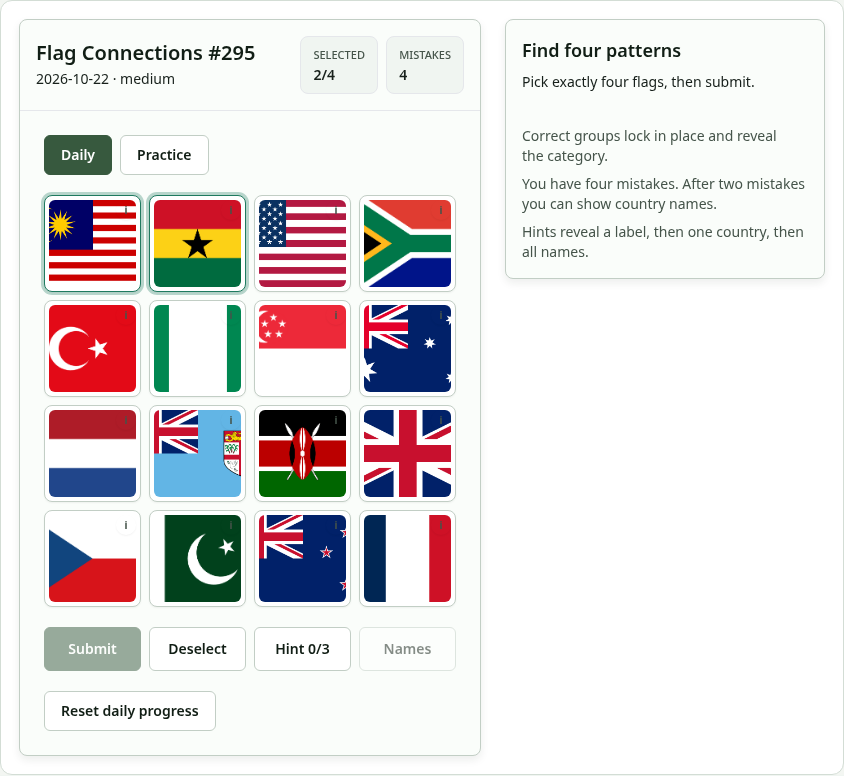
- Scan the 16 flags. The board shows sixteen national flags in random order. Four groups of four flags are hidden among them.
- Select four flags. Tap four flags you think share a connection, for example four flags with a crescent.
- Submit the group. If all four belong together, the group is locked in with its label and colour. If not, you lose one of your four mistakes.
- Use hints carefully. You have three hints. The first reveals a group label, the second reveals one flag from an unsolved group and the third shows country names under the flags.
- Solve all four groups. Clear the board before you run out of mistakes to win. Each group comes with a short explanation.
- Practise any time. Switch to practice mode for extra puzzles that do not affect your daily streak.
What Is Flag Connections?
Flag Connections is a daily flag game that turns sixteen national flags into a logic puzzle. The flags are shuffled together on one board, and hidden among them are four groups of four. Your job is to work out what links each group and select the four flags that belong together. A group might be flags with a crescent, Nordic cross flags, flags with stars or South American countries. Some connections are visual, some are geographic, and the trickiest puzzles mix both. Most puzzles include a red herring: a flag that seems to fit two groups at once.
If you enjoy word-grouping games, you will feel at home right away, but you need a different kind of knowledge. Instead of synonyms and wordplay, you need to notice symbols, layouts and colours, and to remember where countries are. That makes Flag Connections an excellent way to strengthen your general flag knowledge while having fun.
Rules and Scoring
| Rule | Detail |
|---|---|
| Board | 16 flags |
| Goal | Find 4 groups of 4 |
| Mistakes allowed | 4 |
| Hints | 3 (group label → one flag → country names) |
| Difficulty colours | Yellow, blue, green, purple |
| Modes | Daily puzzle and practice |
Solved groups move to the top of the board with their label and a short explanation of the connection. Your share card shows the order in which you found the groups and how many mistakes you made, without revealing the answers.
Tips and Strategies
Start with the most obvious group, but double-check
If you spot five flags with stars, one of them belongs to another group. Before submitting, look for a second connection that could claim one of your candidates. The red herring is usually the flag that fits two categories.
Think in three dimensions: symbols, layout, place
Every flag can be described by its symbols (stars, crescents, suns, animals), its layout (horizontal stripes, vertical tricolour, cross, canton) and its geography (continent, region, island or landlocked). When a group is not obvious, go through the board three times, once for each dimension.
Leave the hardest group for last
Once three groups are solved, the last four flags belong together automatically. Solve the groups you are confident about first, and your remaining mistakes will be saved for the difficult ones.
Use hints in order of value
The first hint, a group label, is often all you need. Save the third hint, which shows country names, for the end. It is most useful when you can see the pattern but cannot name the flags.
Learn common flag groupings
Groupings come up again and again. It helps to know them:
- Nordic crosses: Denmark, Norway, Sweden, Finland, Iceland.
- Crescents: Turkey, Pakistan, Malaysia, Singapore, Algeria, Tunisia, Mauritania, Azerbaijan, Uzbekistan, Turkmenistan, the Maldives.
- Union Jack in the canton: Australia, New Zealand, Fiji, Tuvalu.
- Suns: Argentina, Uruguay, Japan, Kazakhstan, Kyrgyzstan, Malawi, Rwanda, Namibia, the Philippines, Taiwan.
- Vertical tricolours: France, Italy, Ireland, Belgium, Romania, Chad, Mali, Guinea, Nigeria, Peru.
Features
- Daily puzzle: one shared board each day.
- Practice mode: extra random puzzles for training.
- Three-step hints: label, flag, then names.
- Explanations: learn why each group belongs together.
- Difficulty colours: see at a glance how hard each group was.
- Spoiler-free sharing: emoji results to post or send.
- Saved progress and stats: streaks and wins stored in your browser.
Why Grouping Puzzles Work So Well with Flags
Grouping puzzles became hugely popular because they reward lateral thinking: the satisfaction comes from seeing a pattern that was hiding in plain sight. Flags are perfect for this. Hundreds of countries have chosen from a small set of colours and symbols, so the same patterns show up across continents. A red disc appears on the flags of Japan and Bangladesh; a cedar tree is unique to Lebanon; and stars appear on more than sixty national flags. Learning these overlaps is the heart of vexillology, and Flag Connections turns that knowledge into a game.
Playing regularly also builds real geographic understanding. Groups such as Pan-African colours or Pan-Arab colours explain shared history, and regional groups help you place countries on the map. Many players say they learn more from one round of Flag Connections than from an hour with a flashcard deck.
Keep Playing
Need a warm-up? Try Guess the Flag for single-flag recognition, Flag Fragment for close-up detail and Flag Puzzle for a relaxed tile challenge. Afterwards, build a collage of your favourite flags with the Flag Grid Maker.