 Flag Grids
How to Play Guess the Flag
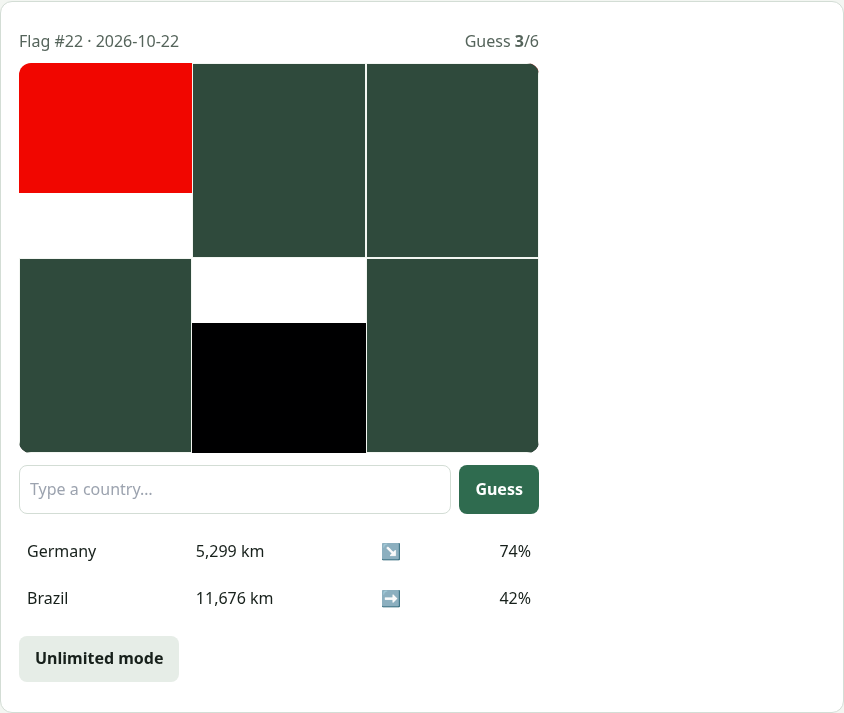
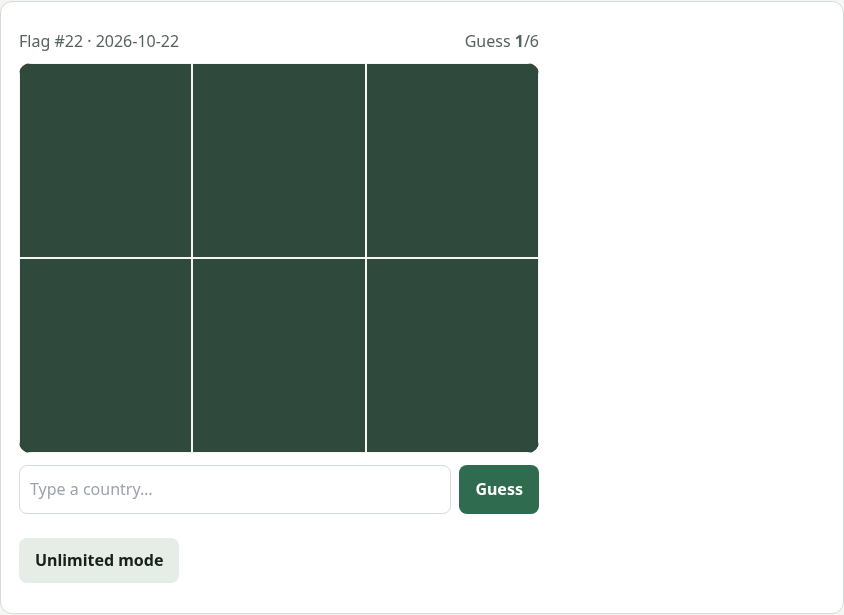
- Look at the hidden flag. Today's flag sits under six dark tiles. One tile is revealed after every guess.
- Type a country. Start typing and pick a country from the suggestions, then press Guess. Common alternative names such as Czechia or Ivory Coast are accepted.
- Read the feedback. Each row shows the distance in kilometres from your guess to the answer, an arrow pointing toward the answer and a proximity percentage.
- Use the new tile. A wrong guess removes one tile. Combine the colours and symbols you can see with the distance and arrow to narrow the region.
- Solve within six guesses. Name the correct country to win. Your result, streak and guess distribution are saved in your browser.
- Share your score. Copy an emoji summary of your round and compare it with friends. Come back tomorrow for a new flag.
What Is Guess the Flag?
Guess the Flag is a daily flag guessing game for anyone who loves geography, travel or vexillology, the study of flags. Each day the game picks one country and hides its national flag under a grid of six tiles. You have six attempts to name the country. After each wrong answer one tile disappears, so the flag becomes easier to recognise, and you also get three geographic clues: the distance from your guess to the mystery country, an arrow showing the direction you need to travel and a proximity score from 0 to 100 percent.
That mix of visual and map-based hints is what makes this flag quiz different from a simple multiple-choice test. You are never just guessing at random. Even a wrong first guess tells you a great deal: if you guess Germany and the arrow points south-east with a distance of 6,000 km, the answer is probably in East Africa or the Middle East. When the first tile then shows a patch of green, you can rule out most of the region before your next try.
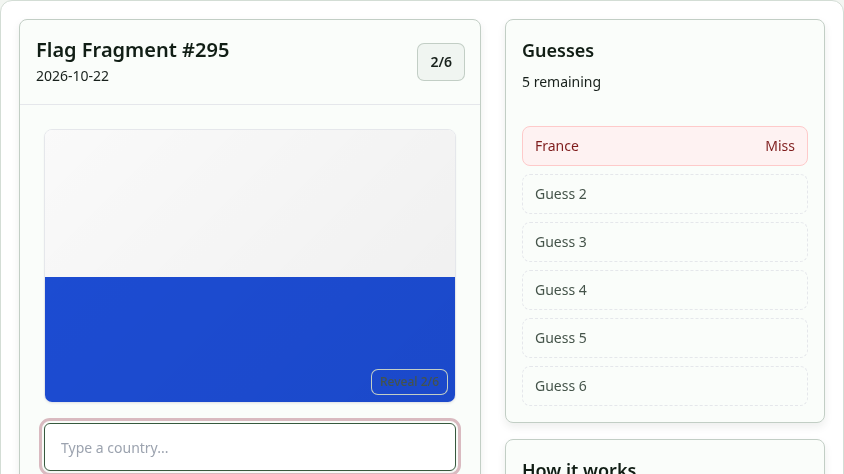
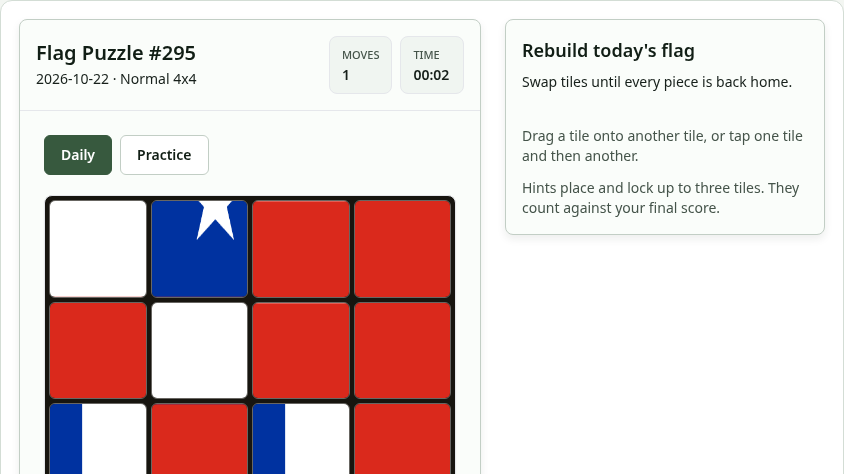
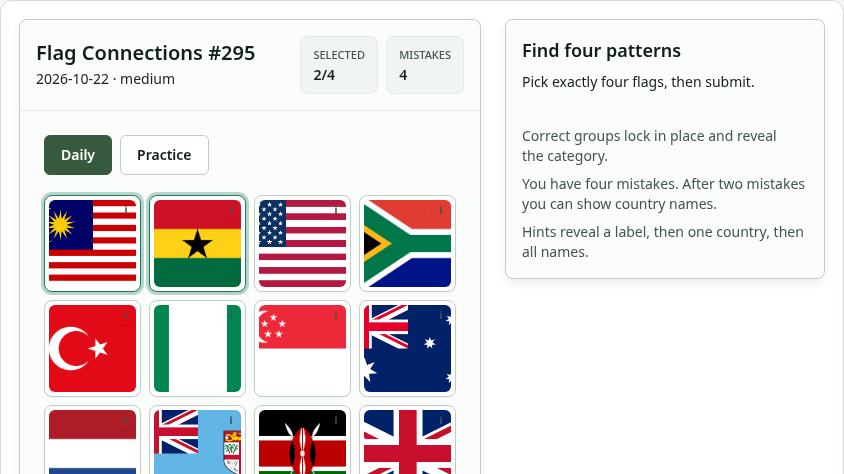
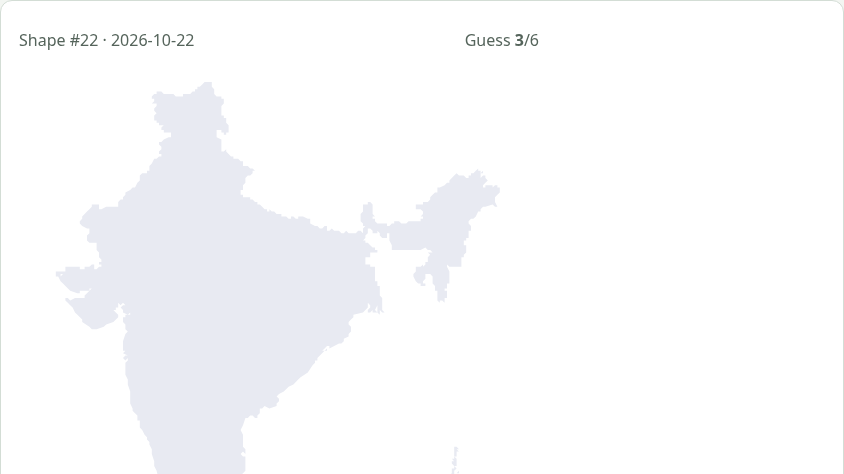
The game is completely free, runs in any modern browser on desktop and mobile, and needs no download, account or app. It is one of several original games on Flag Grids, alongside Flag Fragment, Flag Puzzle, Flag Connections and Country Shape.
Rules and Scoring
| Rule | Detail |
|---|---|
| Guesses | 6 per puzzle |
| Tiles | 6 tiles; one is removed after every wrong guess |
| Feedback | Distance (km), compass arrow, proximity % |
| Country pool | 197 countries, no territories |
| New puzzle | Midnight, your local time |
| Statistics | Games played, wins, current streak, best streak |
A round ends when you name the right country or use all six guesses. If you miss, the full flag is revealed along with the country’s region, population and area, so every round teaches you something. Your streak counts consecutive days on which you solved the daily flag; playing the archive or unlimited mode does not change it.
Tips and Strategies to Guess the Flag Faster
1. Use your first guess to find the continent
Do not waste guess one on a wild shot. Pick a large, central country, for example Germany for Europe and Africa, Kazakhstan for Asia or Brazil for the Americas, and let the distance and arrow do the work. A big, central first guess gives the most useful arrow.
2. Learn the flag families
Many flags belong to families that share colours for historical reasons. Learning them turns one revealed tile into a shortlist:
- Pan-African colours (green, gold, red): Ghana, Senegal, Mali, Guinea, Cameroon, Ethiopia and others.
- Pan-Arab colours (red, white, black, green): Jordan, Palestine, Sudan, the UAE, Kuwait, Iraq, Syria.
- Pan-Slavic colours (white, blue, red): Russia, Serbia, Slovakia, Slovenia, Croatia, Czechia.
- Nordic cross: Denmark, Norway, Sweden, Finland and Iceland.
- Southern Cross stars: Australia, New Zealand, Samoa, Papua New Guinea and Brazil.
3. Watch for symbols
A crescent points toward North Africa, the Middle East, Turkey, Pakistan, Malaysia or the Maldives. A maple leaf, cedar or dragon is almost an instant answer. A coat of arms in the centre is common in Central America and parts of Europe. Even the edge of a symbol in a single tile can be decisive.
4. Trust the proximity score
A proximity above 80 percent usually means the answer borders your guess or is very close to it. Below 30 percent you are on the wrong side of the world. Combine the arrow with the proximity to draw a rough circle on your mental map.
5. Practise with unlimited mode and the archive
The fastest way to improve is volume. Play ten rounds of unlimited mode, note every flag you missed and look them up. Then try a few past puzzles before the daily game.
Features
- Daily flag quiz: one shared puzzle for everyone each day, perfect for a morning routine.
- Unlimited mode: endless random flags for practice.
- Archive: replay every daily puzzle since launch.
- Progressive hints page: reveal clues one at a time without spoiling the whole answer.
- Statistics and streaks: track wins and your longest streak.
- Emoji sharing: post your result without spoilers.
- Accurate data: flags from the open-source flag-icons project and country positions from public datasets.
Why Flag Quizzes Are So Popular
Flag quizzes are one of the oldest geography games, and daily versions became a craze after word games like Wordle showed how much fun a single shared puzzle can be. Guessing a flag is quick, works on any screen and rewards knowledge you pick up from travel, sport and the news: every Olympic Games and World Cup puts dozens of flags in front of millions of people. Flags also have rich stories. Colours often stand for independence movements, religions or landscapes, and symbols such as the Dharma wheel on India’s flag or the AK-47 on Mozambique’s flag tell you a lot about a country’s history.
A daily flag guessing game is also a gentle way to learn. Teachers use flag quizzes to introduce world geography, families play them together, and many players use them to prepare for travel. Because each wrong guess teaches you where a country is, you learn the map as well as the flags. After a few weeks most players can identify far more than the usual 30 or 40 famous flags.
Guess the Flag vs. Other Flag Games
If you enjoy this game, each of the other games on Flag Grids trains a slightly different skill. Flag Fragment shows only a small crop of a flag and zooms out as you guess, so it tests detail recognition. Flag Puzzle is a sliding-tile style challenge about remembering how a flag is laid out. Flag Connections asks you to sort sixteen flags into four themed groups. For pure map knowledge, try Country Shape or Higher or Lower: Population.